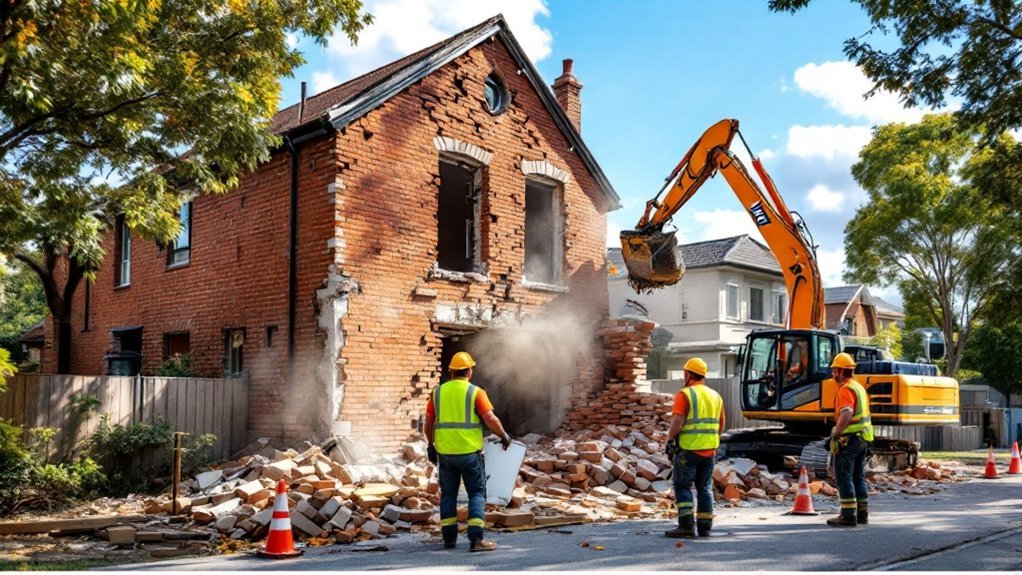
Demolishing a Brick House in Melbourne
When demolishing a brick house in Melbourne, we must secure a mandatory building permit under the Building Act 1993 and check heritage restrictions. We engage licensed demolition contractors who manage permits, arrange utility disconnections with proper notice, and handle asbestos inspection and removal per WorkSafe standards. Salvaging materials helps control costs, while thorough debris disposal guarantees environmental compliance. Confirming pool deregistration can avoid liabilities. Understanding these steps guarantees safety and legal compliance as you prepare for your project’s next phase.
Why You Need Permits and How to Get Them in Melbourne
Why do we need permits to demolish a brick house in Melbourne? Under the Building Act 1993 (Vic), obtaining a building permit is mandatory for any structural demolition. This guarantees demolition is conducted safely with proper assessment, including asbestos inspections and licensed contractor proof.
For homes within heritage overlays, such as in City of Melbourne or Yarra, a planning permit is also required to comply with heritage prohibitions under the Heritage Act 2017 (Vic). Properties listed individually on the Victorian Heritage Register face outright demolition bans.
Ignoring these permit requirements can trigger severe permit penalties, including fines or legal action. The process typically takes a minimum of 20 business days and requires submission of detailed demolition methods. Obtaining the correct permits protects us, the community, and preserves Melbourne’s architectural heritage.
How to Choose an Experienced Demolition Contractor
Selecting an experienced demolition contractor is essential to guarantee safe, compliant, and efficient brick house removal in Melbourne.
Contractor vetting should include verifying a valid Victorian Building Authority license and expertise in full brick demolition, as brick structures require specialized equipment and multiple tipper loads, influencing cost estimation typically between $22,000 and $40,000 for a double-storey brick veneer home.
Confirm the contractor manages all council and building permits, especially in heritage overlay zones where planning permits add complexity.
Guarantee they provide utility disconnection coordination to eliminate hazards before demolition, with related costs factored into your budget.
A thorough waste management plan that prioritizes recycling inert materials like brick and concrete can reduce disposal expenses.
Rigorous vetting guarantees safety, regulatory compliance, and accurate cost estimation for your project.
Why Asbestos Removal Is Crucial Before Demolition
Before we start demolition, it’s critical to identify and safely remove any asbestos-containing materials from the property.
Given that many Melbourne brick houses built before 1990 likely contain asbestos, conducting a thorough asbestos inspection by a qualified assessor is a mandatory first step under WorkSafe Victoria regulations.
This inspection provides essential documentation for demolition permits and guarantees compliance with safety laws.
Hazardous removal must be performed by licensed professionals—Class B removalists for bonded asbestos over 10 square meters, and Class A for any friable asbestos—to prevent toxic exposure.
Improper handling is both illegal and dangerous.
Proper disposal requires double-wrapped, labelled waste and transport records, with fees between $150 and $400 per tonne at licensed Victorian facilities.
Early detection through asbestos inspection guarantees a controlled, lawful demolition process.
What Service Disconnections You Must Arrange First
Before we begin demolition, we must notify all relevant utility providers to arrange disconnection of electricity, gas, water, and sewerage services.
This process requires documented confirmation to comply with building permit conditions and typically takes up to 20 business days.
Verifying that all services are completely disconnected guarantees site safety and prevents hazards during demolition.
Utility Provider Notifications
Although demolition might seem straightforward, we’ve got to arrange disconnection of all utility services—electricity, gas, water, and sewerage—before any work starts.
Proper utility provider notifications are essential to comply with building permits and mitigate risks like fire, electrocution, or flooding.
Timeline planning is critical, as gas and electricity disconnections require at least 20 business days’ notice.
Coordination challenges arise because the property owner must manage these notifications, ensuring verified disconnections before demolition.
Key points to weigh:
- Provide utility providers with minimum 20 business days’ advance notice
- Confirm disconnections in writing to comply with permit requirements
- Prepare for additional costs ranging from $500 to $2,000 due to service abolishment
Addressing these issues upfront keeps the demolition project safe, efficient, and compliant.
Verification Before Demolition
Several critical service disconnections need arranging and verification prior to demolition to guarantee site safety and regulatory compliance. We must coordinate utility capping for electricity, gas, water, and sewerage services well in advance, typically allowing at least 20 business days.
Electricity disconnection requires contacting the network distributor to remove the service line and meter safely. Gas capping must be done by a licensed plumber or gas operator to prevent leaks. Water and sewerage lines are sealed off by the local water authority to avoid flooding hazards.
Before any heavy machinery enters the site, a thorough site safety inspection confirms all disconnections are completed and secure. This verification is essential to eliminate risks of fire, electrocution, or structural instability during demolition.
How Recycling and Salvage Rights Can Lower Costs
When we engage a demolition contractor in Melbourne operating under salvage rights, the value of recycled materials directly offsets the overall project cost. Salvage rights empower contractors to recover and sell items like heritage bricks, doors, and cabinetry, passing recycling savings onto us.
On-site segregation of clean materials reduces tipping fees, as inert waste disposal is less costly than mixed debris.
Here’s how we benefit:
- Heritage bricks can fetch $0.50 to $1.50 each, lowering demolition expenses.
- Salvageable fittings and fixtures generate resale revenue under salvage rights.
- Pre-clearing materials ourselves decreases labor needs and disposal volumes.
Adopting a recycling-focused demolition approach is safer, environmentally responsible, and economically advantageous, providing tangible cost reductions without compromising operational standards.
How to Minimise Disruption and Keep Neighbours Informed
Maximising recycling and salvage benefits helps control demolition costs, but we also need to manage the impact on nearby residents carefully. To minimise noise and dust disruptions, we inform neighbours at least one to two weeks before starting, detailing the schedule and noise levels. Contractors install fencing, signage, and dust control systems to guarantee safety and reduce airborne particles. A rock hammer used for brick demolition extends noisy machine operation, so setting expectations is crucial.
| Task | Purpose | Timing |
|---|---|---|
| Neighbour Notification | Noise mitigation & transparency | 1-2 weeks prior |
| Utility Disconnections | Hazard prevention | Before demolition |
| Site Fencing | Public and worker safety | Before work begins |
| Dust Control Measures | Minimise air contamination | Throughout project |
| Scheduling | Manage noise disruption | Fixed start/end dates |
What Happens After Demolition: Planning Your Next Steps
Post-demolition procedures set the foundation for your next construction phase and require strict compliance with regulatory and safety standards. We must initiate a site survey and soil test to comply with the Building Act 1993, ensuring permit costs between $800 and $2,500 are accounted for.
Proper site reuse is critical: clean concrete and masonry debris should be processed separately, reducing tipping fees and facilitating material recycling. For properties with heritage overlays, adherence to council design guidelines remains mandatory to avoid penalties under the Heritage Act 2017.
Key next steps include:
- Securing and budgeting for the required building permits post-demolition
- Organising debris disposal to maximise site reuse and minimise environmental impact
- Confirming deregistration of any pools with local council to avoid inspection liabilities
This thorough planning safeguards safety and regulatory compliance moving forward.
Final Thoughts
In conclusion, demolishing a brick house in Melbourne requires careful planning and strict adherence to safety and legal protocols. We must secure the necessary permits, hire experienced contractors, and guarantee proper asbestos removal to protect everyone involved. Coordinating service disconnections and considering recycling options help cut costs and environmental impact. Finally, clear communication with neighbours and thorough post-demolition planning confirm a smooth, safe shift to your next project phase. Safety and precision are key throughout.