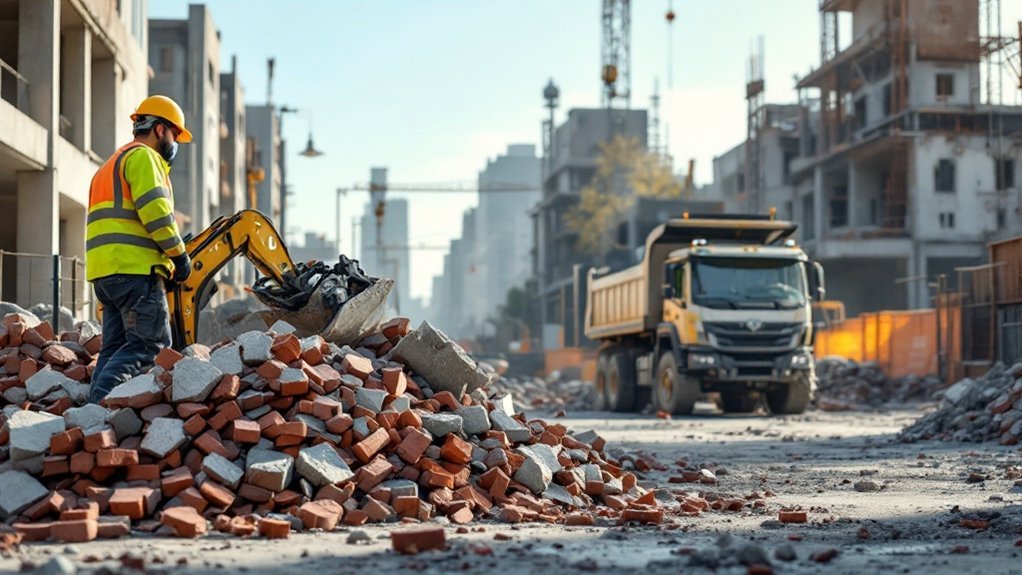
Concrete, Brick and Rubble Disposal After Demolition
We handle concrete, brick, and rubble disposal by following strict recycling protocols and legal requirements. Clean materials go to facilities like West Metro or Repurpose It, while hazardous waste, including asbestos, requires licensed removal and specialized transport. Preparing demolition waste involves sorting and crushing to maximize reuse and reduce contamination. Costs vary by volume and handling needs, with recycling rates up to 98%. Proper planning guarantees compliance and environmental safety. Keep exploring for insights on costs, processing, and legal frameworks.
What Types of Concrete, Brick, and Rubble Are Accepted for Recycling
Regarding recycling, facilities like West Metro Recycling Centre and Repurpose It accept clean concrete, bricks, tiles, blocks, and rubble as accepted materials.
Sydney-based Alex Fraser also manages bricks and tiles recycling, offering drop-off or collection services.
Cleanaway processes mixed demolition rubble, including broken bricks and concrete, while SUEZ handles both reinforced and unreinforced concrete and bricks through their collection service.
It’s important to note the distinction between accepted materials and prohibited items: sand and rubble are accepted at West Metro, but soil is explicitly prohibited since it doesn’t fall under the accepted waste types.
How to Prepare Demolition Waste for Disposal and Recycling
Before we plunge into disposal and recycling, it’s essential to have a waste management plan in place, especially under Queensland’s Waste Reduction and Recycling Act 2011. This plan must detail how concrete, bricks, and rubble will be separated, handled, and transported by licensed waste carriers to compliant facilities.
To maximize landfill alternatives, materials like concrete and bricks should be crushed for reuse as construction base. While some facilities require minimal sorting—thanks to advanced recovery technology—sorting incentives can still reduce contamination and processing costs.
Clean materials from demolition, including mixed rubble, can be recycled through services like skip bins or centres equipped for recovery. Adhering to these practices guarantees regulatory compliance and supports sustainable waste diversion from landfill.
Where to Take Your Concrete, Bricks, and Rubble After Demolition
Finding the right facility for disposing of concrete, bricks, and rubble after demolition depends largely on your location and specific waste type.
In Perth, permitted facilities such as West Metro Recycling Centre and Perth Transfer Station at 48 Kelvin Rd, Maddington, WA are your nearest centers for clean materials.
Melbourne offers options like Repurpose It at 460 Cooper Street, Epping, which accepts mixed rubble without pre-sorting, alongside Alex Fraser’s drop-off and collection services reachable at 136 135.
Queensland contractors must use licensed waste transporters and disposal facilities to guarantee compliance with the Waste Reduction and Recycling Act 2011.
Additionally, SUEZ provides recycling for reinforced and unreinforced concrete and mixed construction waste, accessible via 13 13 35.
Always verify services with permitted facilities to guarantee proper disposal.
What Costs Are Involved in Disposing of Concrete and Brick Waste
Once we’ve identified where to take concrete, bricks, and rubble after demolition, understanding the disposal costs becomes our next step. Pricing calculations mainly depend on waste volume, customer status, and facility fees.
Commercial clients often receive discounts reflecting higher waste quantities and ongoing partnerships. For example, West Metro Recycling Centre lists bulk waste fees online, aiding clear budget forecasts.
Skip bin hire, ranging from 3m³ to 10m³, also factors into costs, with competitive rates and delivery services. Queensland contractors must use licensed waste transporters and facilities to avoid hefty fines, adding compliance costs.
Hazardous materials like asbestos require specialized handling, increasing disposal expenses. Overall, transparent pricing calculations and negotiation for commercial discounts help us manage costs efficiently while complying with regulations.
How Demolition Waste Is Processed and Turned Into Reusable Materials
Let’s explore how advanced Material Recovery Facilities (MRFs) manage demolition waste, converting over 80% into useful products like road base and aggregates.
This process reduces landfill volumes while also conserving natural resources by recycling materials such as concrete, brick, steel, and timber. Understanding these benefits highlights the efficiency and environmental impact of modern recycling methods in demolition projects.
Advanced Material Recovery
Advanced Material Recovery Facilities (MRFs) near Perth exemplify how demolition waste is efficiently processed and repurposed.
These advanced recovery sites handle over 1 million tonnes annually, achieving recycling rates up to 98%.
Through highly efficient sorting and crushing techniques, more than 80% of incoming waste transforms into valuable materials, substantially reducing landfill disposal.
Key outputs include:
- Clean concrete crushed into road base, drainage rock, and aggregates
- Reusable brick and rubble materials for construction applications
- Diversion of thousands of tonnes of waste from landfill each year
This systematic approach both maximizes material reuse but also supports sustainable construction practices by supplying high-quality recycled resources.
It’s a prime example of how technical innovation in recovery processes elevates demolition waste management.
Recycling Process Benefits
When managing demolition waste, we benefit greatly from efficient recycling processes that convert over 80% of materials into reusable products like road base and aggregates.
Advanced Material Recovery Facilities (MRFs) handle more than 1 million tonnes annually, drastically reducing landfill use.
Clean concrete is transformed into road base, drainage rock, and crushed aggregates, while brick and rubble mixed with soil are processed through sophisticated recovery techniques without pre-sorting labor.
This streamlined approach enables landfill diversion rates of up to 98%, substantially lowering the environmental impact of demolition projects.
By prioritizing these recycling methods, we additionally conserve natural resources but also support sustainable construction practices.
The environmental and economic advantages underscore the importance of adopting such efficient demolition waste management strategies.
Managing Hazardous Materials and Asbestos During Demolition Disposal
Before demolition begins, we must make certain asbestos is removed by a licensed professional and all hazardous materials are identified for separate handling.
Proper double-wrapping, labeling, and transport of asbestos and hazardous waste to licensed facilities is essential for compliance.
We also need to maintain detailed documentation to track waste disposal and meet regulatory requirements.
Asbestos Removal Requirements
Although asbestos removal is a critical step in any demolition project, it must be carried out exclusively by licensed asbestos removalists to comply with Queensland’s Work Health and Safety Regulation 2011.
Adhering to asbestos licensing requirements guarantees safety and legal compliance.
Asbestos-containing materials must be carefully handled, double-wrapped, labelled, and transported by approved carriers.
Waste tracking documentation is mandatory for the disposal process, providing transparency and accountability.
Key points to evaluate include:
- Certification such as DWER-approved WARA 1362 is essential for licensed asbestos removalists.
- Asbestos waste must be delivered to licensed hazardous waste facilities under strict protocols.
- Local councils may impose additional rules, so verifying regional requirements is vital.
Proper asbestos removal protects workers, the environment, and streamlines demolition waste disposal.
Hazardous Waste Handling
Hazardous waste management is a critical component of demolition projects, especially when handling asbestos and other dangerous materials like lead-based paints, contaminated soil, and chemical residues.
We must guarantee asbestos is removed by licensed removalists and double-wrapped per standards before demolition.
Additionally, hazardous materials like lead-based paints and chemical residues require separate handling and disposal from general debris.
These wastes must be transported by authorized carriers to licensed hazardous waste facilities, adhering to strict labelling and tracking protocols.
Managing contaminated soil similarly demands careful treatment.
We also need to stay informed on local council requirements to avoid regulatory breaches.
Improper disposal or illegal dumping carries severe penalties, making adherence to hazardous waste handling procedures essential to protecting health and the environment throughout demolition disposal.
Compliance And Documentation
Key practices include:
- Verifying licensed asbestos removal and disposal procedures
- Implementing detailed waste tracking for hazardous substances
- Ensuring all documentation meets Queensland regulatory requirements
Legal Requirements and Waste Management Plans for Demolition Projects
Compliance with Queensland’s legal framework for demolition projects starts with developing a thorough waste management plan before any work begins. This plan details how concrete, bricks, and hazardous materials are separated, transported, and disposed of per the Waste Reduction and Recycling Act 2011. Contractor licensing and project timelines must align with strict legal requirements, including licensed asbestos removal before demolition. Only licensed transporters and disposal facilities guarantee compliance and traceability.
| Requirement | Responsible Party | Key Compliance Aspect |
|---|---|---|
| Waste Management Plan | Project Manager | Detailed material handling |
| Asbestos Removal | Licensed Removalist | Double-wrapped, labelled waste |
| Waste Transport & Disposal | Licensed Contractors | Use licensed facilities only |
Adherence prevents costly fines and environmental penalties.
Tips for Minimizing Disposal Costs and Maximizing Recycling Benefits
In managing concrete, brick, and rubble disposal, maximizing recycling and cutting costs go hand in hand.
To achieve cost savings and landfill avoidance, we should focus on smart planning and efficient processing. Developing a waste management plan before demolition guarantees material separation, reducing contamination and increasing recycling rebates.
Utilizing on-site crushing services minimizes transport costs while producing reusable aggregates for the project. Additionally, sending clean materials to specialized facilities can yield up to a 98% recycling rate, substantially lowering disposal fees.
Key tips include:
- Prepare a demolition waste management plan for effective material separation.
- Use on-site crushing services to reduce transport and landfill costs.
- Choose advanced recovery facilities that handle mixed rubble and soil, cutting handling fees.
Together, these strategies optimize recycling benefits and reduce overall disposal expenses.
Final Thoughts
In managing concrete, brick, and rubble disposal after demolition, we’ve learned the importance of proper sorting, preparation, and legal compliance. By understanding accepted materials, recycling options, and cost factors, we can effectively reduce waste and maximize reuse. Handling hazardous substances carefully guarantees safety and adherence to regulations. With strategic planning, we can minimize disposal costs while supporting sustainable demolition practices. Together, these steps help us achieve efficient, responsible waste management in every project.