
Commercial Demolition Planning for Shops, Offices and Warehouses
When planning commercial demolition for shops, offices, or warehouses, we start by securing all permits, including council and building approvals, which typically take 4 to 12 weeks. We conduct thorough hazard assessments, including asbestos testing and structural surveys, to guide safe strip-outs. Selecting demolition methods depends on building type and site constraints, while waste is sorted for recycling to optimize costs and sustainability. Licensed contractors guarantee compliance and manage safety protocols. Exploring each step carefully leads to a well-coordinated project.
Preparing Your Site and Securing Necessary Permits for Commercial Demolition
Before starting any commercial demolition, we need to focus on thorough site preparation and the careful securing of all necessary permits. Permit timelines typically span 4 to 12 weeks, with council approvals alone requiring 4 to 8 weeks.
We must obtain building approval from a licensed certifier, supported by precise, scaled plans from a draftsperson or architect. For sites in principal or major centre zones, or with heritage overlays, planning approval is mandatory.
Asbestos removal is a vital step prior to demolition, involving 1 to 2 weeks for testing and 3 to 10 days for licensed removal.
Additionally, we guarantee separate permits, such as footpath permits for truck access and plumbing approvals for sanitary drain capping, are secured. This structured approach guarantees compliance and safety on commercial demolition sites.
How to Assess Building Hazards and Plan for Safe Strip-Outs and Demolition
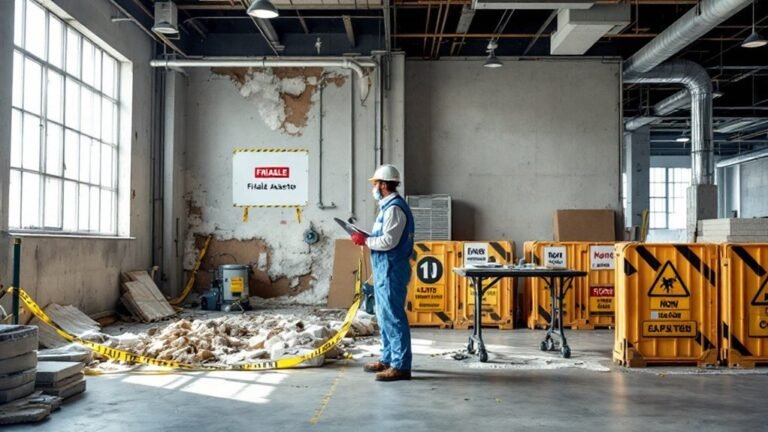
With all permits in place and site preparation underway, we turn our focus to identifying and managing potential building hazards to guarantee a safe strip-out and demolition process. Asbestos testing by licensed professionals is mandatory, often requiring 1–2 weeks, with removal time added if detected. Structural surveys thoroughly assess integrity, utility disconnections, and environmental risks, guiding our detailed demolition plan. Controlled internal strip-outs preserve structural stability during interior removals with rigorous safety protocols.
| Hazard Type | Key Considerations |
|---|---|
| Asbestos & Lead Paint | Specialized removal, regulatory compliance, disposal costs |
| Structural Integrity | Damage risk, engineering controls |
| Utilities | Safe disconnections, service shutdowns |
This systematic hazard assessment guarantees compliance, safety, and efficiency throughout strip-out and demolition.
Choosing the Right Demolition Methods for Shops, Offices, and Warehouses
Although demolition methods vary widely, selecting the right approach for shops, offices, and warehouses hinges on factors such as building size, material composition, site constraints, and occupancy status.
In method selection, mechanical demolition with excavators suits small to medium buildings, balancing speed and cost—typically 3–21 days depending on size. Controlled implosion offers the quickest timeline but demands strict permitting and isolated sites, fitting only large structures. For occupied offices or retail centers, soft strip-out guarantees safe removal of interiors while maintaining structural integrity. Deconstruction is slower but maximizes material recovery for steel, timber, and bricks.
We must also consider material type—concrete and steel extend timelines—and regulatory requirements like noise control. By systematically evaluating these factors, we optimize method selection to align with project timelines and site specifics efficiently.
Managing Waste Removal and Recycling After Commercial Demolition
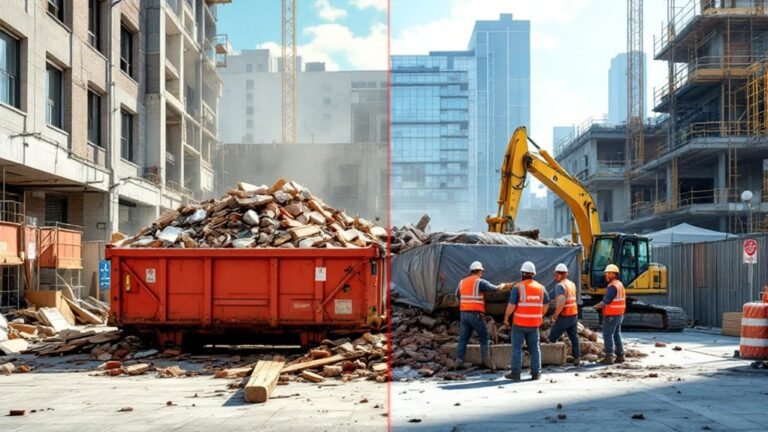
Effective waste removal and recycling after commercial demolition require careful sorting of materials such as concrete, bricks, timber, and steel to guarantee proper processing at EPA-approved facilities. We focus on separating these materials on-site to maximize recycling efficiency and reduce landfill disposal.
By implementing sustainable practices, we can generate significant cost savings through material resale and lower disposal fees. Collaborating with specialized recycling companies further reduces transportation and tipping costs while optimizing waste diversion. Additionally, we explore available government incentives and rebates for sustainability efforts.
The debris removal and site rehabilitation process typically spans 1 to 4 weeks, allowing adequate time for sorting, recycling, and any necessary soil remediation. This structured approach guarantees compliance, environmental responsibility, and financial efficiency throughout waste management after demolition.
Hiring Licensed Contractors and Ensuring Compliance Throughout the Project
In steering commercial demolition projects, engaging licensed contractors who understand local regulations is essential to guarantee full compliance throughout every stage. They manage permits, asbestos removal, and safety measures, guaranteeing the project timeline stays on track and cost estimation is accurate. Understanding local requirements—like Queensland’s heritage and safety laws—prevents costly delays.
| Compliance Aspect | Requirement | Impact on Project |
|---|---|---|
| Licensing | Contractor must be licensed | Guarantees regulatory compliance |
| Permits | Council approvals, 4–12 weeks | Affects project timeline |
| Hazardous Materials | Asbestos handled by professionals | Avoids fines and unexpected costs |
| Safety Measures | Barriers, traffic plans (2–5 days) | Maintains worker and public safety |
We recommend prioritizing licensed professionals for efficient execution and reliable cost estimation.
Final Thoughts
As we plan commercial demolitions for shops, offices, and warehouses, thorough preparation and permit acquisition set the foundation. Evaluating hazards and carefully planning strip-outs guarantee safety, while selecting appropriate methods maximizes efficiency. Proper waste management supports sustainability, and hiring licensed contractors guarantees regulatory compliance. By systematically addressing each phase, we can execute demolition projects smoothly, minimizing risks and disruptions while optimizing resource use. This organized approach drives successful outcomes every time.