
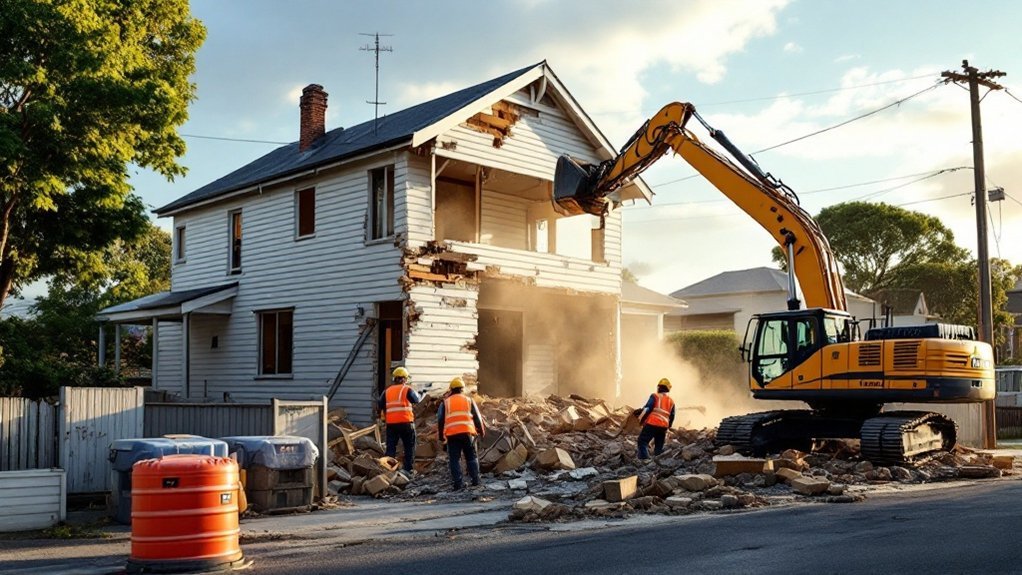
Demolishing a Weatherboard House in Melbourne
When demolishing a weatherboard house in Melbourne, we focus on managing costs, which typically range from $12,000 to $20,000 due to lighter timber framing and simpler construction. We prioritize an asbestos inspection and licensed removal, especially for homes built before 1990, adding about $2,500 or more. Site access, permits, and utility disconnection also affect pricing. We guarantee strict safety compliance and efficient debris recycling to control expenses. Exploring these factors will clarify how to plan your demolition effectively.
How Much Does It Cost to Demolish a Weatherboard House in Melbourne?
When we look at demolishing a weatherboard house in Melbourne, costs typically range from $10,000 to $40,000, with timber structures usually cheaper to take down than brick or concrete ones. The average cost for a standard timber demolition hovers around $17,000, influenced by house size and material salvage potential.
We must carefully manage the demolition timeline, allowing adequate time for asbestos inspection and removal if the house dates from 1920 to 1990, as this adds about $2,500 due to specialist handling.
Insurance requirements are strict; contractors must carry public liability and workers’ compensation to mitigate risks during demolition.
Understanding these factors helps us plan efficiently, ensuring safety and regulatory compliance while managing costs and timelines effectively.
What Makes Weatherboard Homes Easier and Cheaper to Demolish?
Over time, weatherboard homes have proven easier and more cost-effective to demolish compared to brick or concrete structures, primarily due to their lighter timber framing and simpler construction.
The lower material density results in reduced debris volume, which cuts down on transportation and disposal fees at recycling centers.
Timber-framed walls can be efficiently removed using standard machinery, eliminating the need for heavy equipment, thereby lowering both labor and operational costs.
Additionally, weatherboard demolitions often qualify for permit exemptions or simplified approval processes, expediting project timelines and further reducing expenses.
The potential for material recycling is significant, as salvaged timber and boards can be repurposed or sold.
When Asbestos Removal Adds to Demolition Costs
When demolishing weatherboard houses built before 1990, an asbestos inspection is essential to identify hazardous materials.
Removing asbestos requires licensed professionals who follow strict safety protocols, substantially increasing labour and disposal costs.
These specialist expenses can add several thousand dollars to the overall demolition budget, making early assessment critical for accurate planning.
Asbestos Inspection Necessity
Although demolishing a weatherboard house might seem straightforward, conducting a thorough asbestos inspection is essential before we proceed.
Given the high likelihood of asbestos in homes built between 1920 and 1990, we must address both public health concerns and legal liability risks upfront.
Key considerations include:
- Identifying asbestos presence early to avoid unsafe exposure.
- Complying with Melbourne regulations requiring licensed removal for pre-2003 buildings.
- Preventing costly project delays by detecting hazardous materials before demolition.
- Allocating budget accurately, as asbestos removal can triple demolition costs.
This inspection both safeguards workers and neighbours and also guarantees our demolition aligns with legal standards, ultimately protecting everyone involved from health risks and potential liabilities.
Specialist Removal Expenses
Demolishing a weatherboard house containing asbestos requires specialist removal services that substantially impact the overall project cost. Asbestos removal can add around $2,500 or more, tripling expenses compared to standard demolition debris.
This is due to acute health risks, stringent safety protocols, sealed containment requirements, and the need for licensed contractors who handle hazardous material safely. Hidden structural damage often complicates removal, as disturbed asbestos fibres pose severe inhalation risks if mishandled.
Compliance with strict disposal regulations and the use of specialised equipment further escalate costs. To avoid costly delays and permit issues, scheduling an asbestos and mould inspection beforehand is essential.
Ultimately, accounting for these specialist removal expenses guarantees a compliant, safe demolition process while protecting workers and residents from hazardous exposure.
Why Site Access and Location Affect Your Demolition Price
Site access and location play critical roles in determining the cost of demolishing a weatherboard house in Melbourne. Restricted sites often necessitate traffic control measures and utility relocation to guarantee safety and uninterrupted services, directly impacting expenses.
Several factors influence pricing:
- Difficult terrain or steep slopes require specialised equipment like cranes or remote-controlled machinery, increasing transport and operational costs.
- Narrow driveways or limited street access mean using smaller, less efficient machinery, heightening per-metre demolition prices.
- Dense urban locations near neighbours demand slower, more careful demolition methods to minimise risks and noise.
- Easy-access, level sites allow for faster demolition, reducing labour and equipment costs, generally falling within $12,000 to $20,000.
Recognising these site-specific challenges helps us provide accurate, safety-focused project scopes and budget estimates.
What Permits and Paperwork Do You Need Before Demolition?
Steering through the permits and paperwork required before demolishing a weatherboard house in Melbourne is essential to guarantee compliance and safety throughout the project.
First, obtaining Council approval or from a private certifier is mandatory, with permit fees typically ranging between $350 and $700. The application demands submitting specific forms, and processing may take weeks, especially if heritage or tree removal issues apply.
Prior to demolition, utilities such as water, gas, and electricity must be disconnected, potentially incurring additional charges and requiring a temporary builder’s pole installation.
If the house was built between 1920 and 1990, asbestos inspection and specialist removal are compulsory, adding to costs.
Councils also often mandate rodent baiting and adherence to strict site preparation protocols before granting final permission.
How the House Demolition Process Works Step-by-Step
First, we carefully prepare the site by disconnecting utilities, removing hazardous materials like asbestos, and clearing any obstacles to guarantee safety and efficiency.
Once the physical demolition is complete, which usually takes a few days, we focus on thorough site cleanup and debris removal to leave the area safe and ready for its next use.
This structured approach minimises risks and optimises project timelines from start to finish.
Demolition Preparation Steps
Before we start the physical demolition of a weatherboard house, we need to carefully prepare by disconnecting all utilities such as electricity, gas, and water. Electricity is often rerouted to a temporary builders pole, while water may remain on for specific tasks like asbestos removal. To guarantee safety and compliance, licensed specialists must remove hazardous materials, especially asbestos, common in homes built between 1920 and 1990. Obtaining a demolition permit from the local council is mandatory, but permit delays can extend timelines notably.
Our step-by-step demolition preparation includes:
- Securing all required permits to avoid project delays.
- Disconnecting or relocating utilities professionally.
- Engaging licensed experts for asbestos and hazardous material removal.
- Pre-planning site cleanup to streamline post-demolition processes.
Post-Demolition Site Cleanup
What happens right after the physical demolition of a weatherboard house? Our site cleanup crew mobilizes to systematically remove all debris, guaranteeing the area is clean and safe for upcoming construction phases.
We prioritize stockpile management to organize salvaged materials and waste efficiently, preventing hazards and facilitating recycling or disposal.
If necessary, tree and shrubbery clearing is completed during this stage, with costs varying based on extent.
Foundation removal, typically adding a few thousand dollars, is also conducted now to clear the site thoroughly.
Erosion control measures are implemented throughout cleanup to maintain soil stability and prevent runoff.
After site cleaning and excavation, soil testing verifies ground stability, confirming suitability for new builds.
This structured approach guarantees safety, compliance, and readiness for the next development step.
Extra Costs to Watch for After Demolishing a Weatherboard House
When factoring in the true cost of demolishing a weatherboard house, we need to account for several critical post-demolition expenses that often take people by surprise.
Key additional costs include:
- Asbestos disposal fees: Weatherboard houses built between 1920 and 1990 often contain asbestos, adding around $2,500 or more for safe removal and disposal.
- Soil contamination and testing: Local councils might require soil testing to detect contamination or instability, incurring extra charges.
- Foundation removal: Concrete slabs or stumps often need separate removal, costing several thousand dollars.
- Temporary fencing: Necessary for site safety and compliance, fencing costs typically start at $1,000.
Being aware of these guarantees compliance with safety regulations and avoids unexpected budget overruns after demolition.
Smart Ways to Save Money on Your Weatherboard House Demolition
Although demolishing a weatherboard house tends to be faster and less labor-intensive than brick or concrete structures, we can still take targeted steps to reduce costs further. Maximizing salvage profit through debris recycling is key; timber, bricks, and metals can offset expenses substantially. Clearing all furniture beforehand reduces manual labor hours, cutting costs. Finally, obtaining multiple competitive quotes guarantees the best pricing.
| Strategy | Impact on Cost |
|---|---|
| Salvage timber & metal | Earn $800–$12,000 |
| Debris recycling | Decreases landfill fees |
| Remove personal items | Lowers manual labor |
| Avoid foundation removal | Saves $2,000–$5,000 |
| Compare 3+ quotes | Secures competitive rate |
Focusing on these technical, safety-first steps guarantees a cost-efficient demolition process.
Final Thoughts
To sum up, demolishing a weatherboard house in Melbourne involves careful planning, permitting, and managing potential hazards like asbestos. We must consider site access and unexpected costs to guarantee safety and efficiency. By understanding each step— from obtaining permits to handling debris— we can control expenses and mitigate risks. Staying informed and working with experienced professionals helps us complete the demolition responsibly and cost-effectively, prioritizing safety at every stage.