Do I Need Asbestos Testing Before Demolition?
Yes, we treat pre-demolition asbestos testing as mandatory, not optional. Under WHS and NESHAP rules, a certified inspector must identify asbestos-containing materials likely to be disturbed before demolition starts, even if the building looks new or sound. We need results to confirm registers, plan licensed removal, avoid fines, shutdowns, and fibre exposure. The process also affects permits, costs, and timing. Keep going, and we’ll cover when, where, and how it applies in your demolition project.
Do You Need Asbestos Testing Before Demolition?
Yes—we need asbestos testing, or more specifically a pre-demolition asbestos inspection, before demolition begins.
Under Australian workplace safety laws, this inspection isn’t optional; it supports legal compliance and reduces health risks from airborne fibres.
The Occupational Health and Safety Regulations 2017 require us to identify asbestos likely to be disturbed and arrange removal by a licensed asbestos removalist before demolition starts.
If you’re dealing with a commercial property built before 2004, an up-to-date asbestos register must document ACM presence and condition.
We can’t rely on DIY testing either.
Federal and state rules require state-certified asbestos inspectors to conduct surveys for demolition compliance.
Without a proper inspection, we risk exposure, enforcement action, fines, legal penalties, and work stoppages before any demolition activities proceed onsite.
Why Does Pre-Demolition Asbestos Testing Matter?
Before we authorise demolition, we can’t rely on assumptions; we need confirmed asbestos data because disturbing unidentified ACMs can breach WHS obligations and trigger stop-work orders, fines, and remediation.
We protect worker safety by identifying friable and non-friable ACMs early, so we’re applying licensed removal, isolation, PPE, and air-control requirements before dust-generating work starts.
We prevent fibre exposure by treating asbestos as a serious inhalation hazard, since released fibres can cause mesothelioma, asbestosis, and lung cancer that are often fatal and incurable.
Protecting Worker Safety
When we’re planning demolition, pre-demolition asbestos testing isn’t a paperwork exercise; it’s a critical exposure-control measure that identifies friable and non-friable ACMs before workers disturb them with hand tools, unlicensed labour, or inadequate PPE.
Without a licensed survey, teams can unknowingly cut pipe insulation or floor tiles, breaching the Occupational Health and Safety Act 2004 duty to provide a safe workplace.
We also reduce asbestos liability when EPA NESHAP and Australian WHS requirements are met through documented sampling, risk assessment, and removal planning.
If ACMs are found, workers need trained, licensed removalists, appropriate controls, and medical surveillance where exposure risk warrants it.
Testing keeps demolition programs compliant and prevents avoidable asbestosis, pleural disease, lung cancer, and fatal mesothelioma during regulated demolition and refurbishment work.
Preventing Fibre Exposure
By identifying asbestos-containing materials before demolition, we can’t rely on assumptions about what’s safe to disturb.
Under Australian WHS laws, pre-demolition asbestos testing is mandatory, not optional. A competent inspection locates friable materials, such as pipe insulation, and non-friable materials, such as floor tiles, before plant, dust suppression, or demolition sequencing begins.
Once disturbed, these products can generate airborne dust carrying respirable fibres linked to mesothelioma, lung cancer, and asbestosis. Testing lets us apply control measures, isolate work areas, use licensed removalists, and provide correct PPE.
It also reduces regulatory risk; unlicensed removal or inadequate protection has triggered fines and costs. For you, that means fewer work stoppages, lower liability, and stronger protection for workers, neighbours, and the public.
We treat this as core control.
When Is Pre-Demolition Asbestos Testing Required?
We treat pre-demolition asbestos testing as a prerequisite before demolition begins, not an optional site task, because EPA NESHAP and workplace safety rules require a compliant survey.
If you’re disturbing ACMs, or materials that may contain ACMs, testing and identification must be completed before those activities start.
We also require a current asbestos register for applicable pre-2004 commercial properties, and we use state-certified inspectors because DIY testing doesn’t satisfy demolition compliance.
Before Demolition Begins
Once demolition is planned, we can’t treat asbestos testing as optional; it’s a mandatory control before any structural work starts. Under Australia’s workplace safety laws, we need a pre-demolition asbestos inspection before demolition commences, and regulations require a licensed asbestos assessor to identify all asbestos-containing materials.
We can’t rely on age, appearance, or condition; testing applies across all structures and supports environmental compliance, including EPA NESHAP obligations.
For us, the file must document findings, risk controls, and clearance before mobilisation. This protects workers from airborne fibres, prevents work stoppages, enforcement action, and legal penalties, and helps satisfy structural integrity and insurance requirements.
In Queensland, if more than 10 square metres of non-friable asbestos is present, a licensed removalist must remove it before demolition proceeds.
When ACMs May Disturb
Before any demolition or refurbishment activity starts, we’re required to identify any asbestos-containing materials (ACMs) likely to be disturbed, not just the materials we plan to remove.
Under Victorian WHS obligations, we test before work where demolition, cutting, drilling, stripping, or damage could release fibres.
Australian requirements apply regardless of a building’s age or condition.
For commercial properties built before 2004, we also need a current asbestos register to plan safe demolition and avoid shutdowns.
- ACMs behind walls, ceilings, plant rooms, or services may be disturbed unexpectedly.
- Friable or damaged ACMs create urgent airborne fibre risk.
- Disturbance over 10 square metres requires licensed asbestos removal.
- Unidentified ACMs can trigger fines, liability, and stop-work orders.
- Contaminated material needs controlled handling, transport, and waste disposal records.
Which Buildings Need Pre-Demolition Asbestos Testing?
Pre-demolition asbestos testing applies to every building slated for demolition, not just older structures with visible deterioration. We treat residential, commercial, industrial, institutional, and small outbuildings as in scope when demolition is planned.
Under U.S. NESHAP, we need a certified asbestos inspection before demolishing any structure, regardless of size, use, age, or condition. In Australia, workplace safety laws require a pre-demolition asbestos report, and commercial properties built before 2004 must maintain an up-to-date asbestos register.
We also don’t rely on assumptions, pre renovation exemptions, or post disaster assessments unless they include current, site-specific asbestos data. High-risk homes built before the 1980s warrant careful review, but newer buildings still need verification because undocumented ACMs create regulatory and liability exposure during permitting, procurement, and contractor mobilization.
Which Materials Need Testing Before Demolition?
Before demolition starts, we’ll treat pipe insulation and HVAC duct wrap as suspect materials requiring sampling by a licensed inspector, since friable ACM can release fibers as soon as it’s disturbed.
We’ll also test floor tiles and adhesives, because vinyl composition tile and mastic may be non-friable but hazardous when broken, scraped, or abraded.
Roofing felts, shingles, cement siding, and related wall materials need inclusion too, since Category I and II non-friable ACM can trigger RACM controls once demolition begins.
Pipe And Duct Insulation
Pipe and duct insulation are among the materials we can’t treat as low-risk during demolition planning: steam and hot-water pipe insulation often contains friable asbestos, and HVAC duct wrap commonly contains asbestos.
- We don’t assume age alone is enough; buildings constructed before the 1980s require certified asbestos inspector sampling of both pipe and duct insulation.
- Because friable materials can crumble during disturbance, they create elevated inhalation risk for workers, occupants, and receptors.
- If lab results confirm asbestos, we apply stricter containment, wet methods, negative pressure, PPE, and licensed abatement procedures before demolition.
- HVAC duct wrap, pipe lagging, elbows, tees, valves, and fittings should all be inspected; hidden sections still count.
- Under EPA NESHAP, skipping required testing can trigger civil fines, notices, and project shutdowns.
Floor Tiles And Adhesives
Although floor tiles and adhesives often appear stable, we don’t treat them as low-risk during demolition planning: vinyl-asbestos tiles, tile backing, and cutback adhesives/mastics in U.S. buildings constructed before 1978 are presumed asbestos-containing until sampled by a state-certified inspector for EPA NESHAP compliance.
We treat these materials as demolition-sensitive because non-friable asbestos can become airborne when tiles crack, backing delaminates, or adhesive is scraped during mastic removal. If sampling confirms asbestos, we plan licensed abatement before demolition. Australian WHS rules require an independent asbestos assessor to sample floor tiles and adhesives.
In Victoria, unlicensed non-friable vinyl flooring removal is limited to under 10 square meters and no more than one hour in seven days. Without testing, we risk fines, shutdowns, and liability for exposure.
Roofing And Siding Materials
Two roofing and siding groups need testing in our demolition reviews: roofing felts and shingles, and cement-based siding, wallboard, or bonded asbestos sheets.
We treat these as regulated asbestos-containing materials, or ACMs, because demolition impact, cutting, and weathering can release fibres.
Licensed asbestos assessors test samples, record locations, material types, and quantities, and prepare documentation for EPA NESHAP and Australian WHS compliance.
We don’t classify risk by appearance alone; laboratory analysis confirms whether materials are ACMs and guides safe work methods before any disturbance occurs onsite.
- Roofing felts under shingles often hide asbestos.
- Cement shingles may be non-friable until disturbed.
- Cement siding and wallboard need pre-demolition identification.
- Bonded sheets require controlled removal and plastic wrapping.
- Waste must go to an approved ACT NoWaste facility.
Who Can Conduct a Pre-Demolition Asbestos Survey?
Where can we lawfully get a pre-demolition asbestos survey done? We can’t rely on DIY testing or an unqualified contractor. For demolition compliance, federal EPA rules and Australian WHS laws require a state-certified asbestos inspector, and in Australia the Occupational Health and Safety Regulations 2017 require licensed asbestos assessors for pre-demolition surveys.
We should verify certification requirements before appointing anyone, checking their licence and accreditation status. In the ACT, licensed asbestos assessors are listed on public registers, so we can confirm credentials. Their Licensed assessor role is to identify asbestos-containing materials, document findings, and inform removal methodology, not to approve demolition.
We should engage them before demolition planning is locked, because federal law expects all asbestos-containing materials to be identified before demolition projects begin.
What Happens During Asbestos Testing?
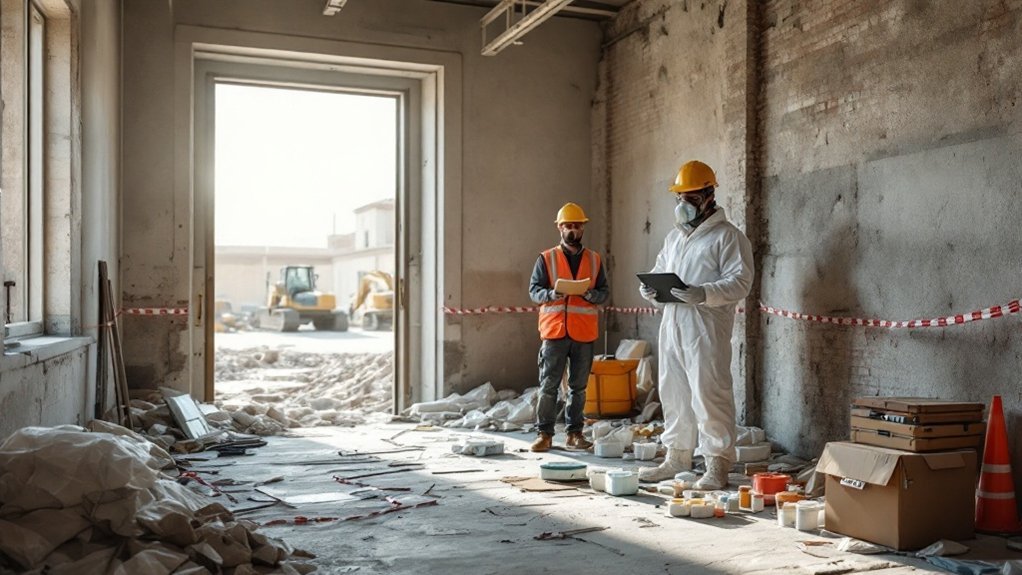
During asbestos testing, we’ll have a state-certified asbestos inspector conduct a thorough survey of the entire site, including concealed and hard-to-reach areas, and use destructive methods where access or building history requires it.
That inspector collects representative samples from suspected ACMs, such as pipe insulation, floor tiles, roofing felts, mastics, and other regulated materials. Each sample is labeled, logged, and sent to an accredited laboratory for sample analysis, while we document locations, material types, quantities, and whether materials are friable or non-friable. The process supports federally compliant demolition planning and prevents DIY testing from creating legal exposure.
- Inspect hidden voids and inaccessible assemblies
- Preserve chain of custody
- Classify friable versus non-friable materials
- Record quantities and demolition-relevant locations
- Complete report creation for later NESHAP review
What Happens If Asbestos Is Found?
If asbestos turns up, we’ll pause demolition until a licensed abatement contractor removes it under strict containment, removal, and disposal controls.
We’ll treat the finding as a regulated hazard, not a minor site issue. The contractor must isolate the work area, use negative pressure, decontaminate workers and equipment, and follow containment procedures. Asbestos waste is double-bagged in leak-tight containers, labelled hazardous, and transported by a licensed hauler to a landfill.
In Australia, non-friable removal over 10 m² needs an A or B class asbestos removal licence; friable asbestos requires a class A licence. After removal, an independent licensed asbestos assessor conducts clearance testing and issues an Asbestos Clearance Certificate. Without clearance, demolition remains non-compliant, exposing us to fines, shutdowns, liability claims, and legal repercussions.
How Does Testing Affect Demolition Cost and Timing?
Once asbestos is confirmed, we’ll move the cost and schedule impact from compliance planning into the demolition budget.
Skipping the required inspection may look cheaper, but it creates stop-work risk, fines, and emergency remediation exposure. A licensed inspection and lab analysis usually adds $300 to $1,000 for a standard residential property, while identified asbestos can require licensed removal costing $1,000 to $5,000 or more.
Regulatory notification can add 10 to 14 days before demolition legally starts. Cost analysis treats testing as a controlled expense, not an optional delay. The timeline impact is real, but predictable.
- Testing prevents unlawful demolition.
- Positive results trigger licensed removal.
- Clearance requirements can pause demolition.
- Noncompliance can exceed $20,000 in penalties.
- Planned abatement protects workers, neighbors, and the site.
How Should You Prepare for Asbestos Testing?
Before demolition starts, we’ll prepare asbestos testing as a formal compliance step, not a convenience check.
We’ll hire a state-certified asbestos inspector to survey the site, including concealed, elevated, and hard-to-reach areas. We’ll require sampling of pipe insulation, floor tiles, roofing felts, ceiling texture, cement siding, and suspect materials, regardless of building age. Samples must go to an accredited laboratory to classify ACMs as friable or non-friable. We’ll require the report to document locations, material types, quantities, removal recommendations, and NESHAP compliance steps. DIY testing won’t satisfy legal demolition requirements.
For Budget planning, we’ll reserve funds for lab fees, retesting, and abatement.
For Schedule coordination, we’ll align inspector access, report review, permits, and any lead-based paint testing required before demolition under the RRP Rule.
Frequently Asked Questions
How Long Does a Pre-Demolition Asbestos Report Remain Valid?
We can’t state a universal Report Expiry date; we treat it as valid only while building’s materials, access, and scope remain unchanged. We recommend renewing it before demolition, especially after Regulatory Updates, delays, or alterations.
Can Demolition Start While Asbestos Test Results Are Pending?
No, we don’t start demolition while asbestos results are pending. We’d keep the area controlled, preserve suspect materials, and await lab confirmation. Starting early creates Regulatory liability, client liability, and unacceptable exposure risk to workers.
Do Tenants or Occupants Need to Vacate During Asbestos Testing?
Yes, we’ll need occupants to vacate during asbestos testing if sampling requires disturbance, containment, or exposure potential. We’ll prioritize tenant safety, document occupant rights, follow regulations, and use risk controls until lab results confirm conditions.
What Happens if Parts of the Building Are Inaccessible?
If we can’t access parts of your building, we document Inaccessible areas, assess hidden risk, note Sampling limitations, and avoid Regulatory loopholes by requiring safe access, destructive inspection, or controlled demolition assumptions before work proceeds.
Are Asbestos Testing Requirements the Same Across Australian States?
No, they’re not identical; State laws and licence requirements vary by jurisdiction, though national WHS duties apply. We’d verify competent sampling, asbestos registers, removal controls, and clearance documentation before demolition to manage ACM exposure risk.
Final Thoughts
We treat pre-demolition asbestos testing as a non-negotiable control, not a box-ticking exercise. Before demolition starts, we’ll help you confirm regulatory requirements, identify suspect materials, and document survey findings properly. If asbestos is present, we’ll plan licensed removal, air monitoring, waste handling, and clearance before work proceeds. That approach reduces enforcement risk, protects workers and occupants, and prevents costly delays from unexpected contamination or incomplete compliance records throughout your demolition programme, from notification to closeout.