Site Clearing Before Construction: What Is Included?
When preparing a site for construction, we remove vegetation like trees, bushes, and debris, including stumps and landfill, to clear the ground. We use specialized equipment matched to terrain—skid steers for flat land and bulldozers or excavators for rugged areas. Grading and soil prep guarantee stability and drainage, while erosion controls protect the environment and meet regulations. Professional clearing also manages permits and site safety. Understanding these steps helps you plan a compliant, efficient project start.
What Vegetation and Debris Are Removed During Site Clearing
We typically start site clearing by removing all vegetation with significant root systems, such as trees and bushes, since these can obstruct foundations and cement work.
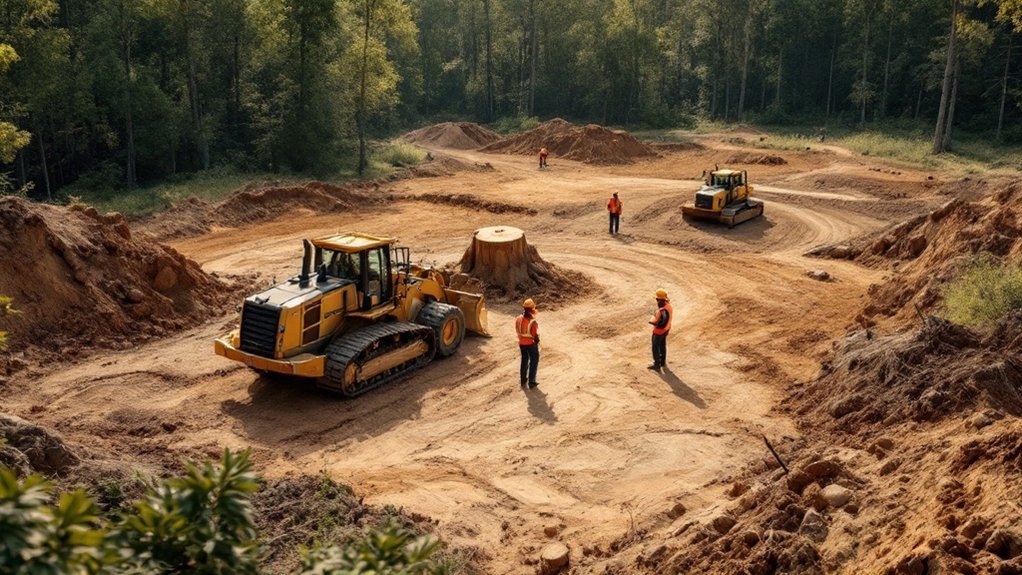
Removal techniques vary by size: smaller trees and bushes are extracted entirely with excavators, while larger trees must be cut to stumps first, followed by separate stump and root removal. We prioritize clearing smaller vegetation to create safe access for equipment handling bigger trees.
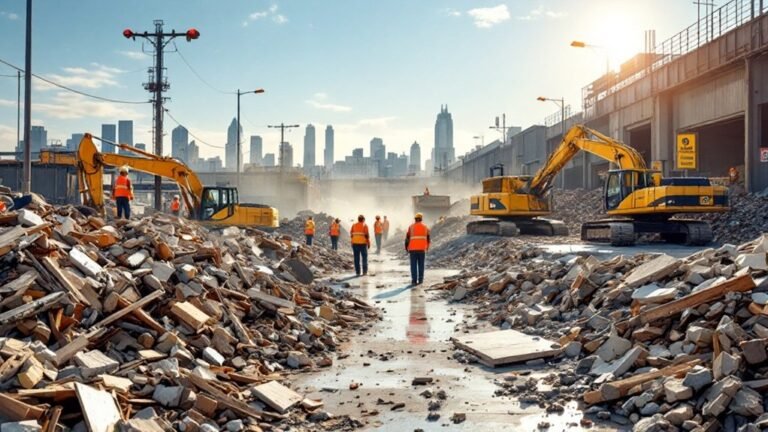
Alongside vegetation, debris like rubbish, landfill, and abandoned infrastructure is cleared to prepare the site. Exposed landfill areas are carefully covered with flattened, contoured soil to prevent erosion.
Effective debris disposal is critical to maintain site integrity and environmental compliance throughout the process, ensuring a clean, stable platform for construction activities.
How Equipment and Techniques Vary by Terrain and Vegetation
Clearing a site calls for adapting equipment and methods to the terrain and vegetation involved. On flat, lightly wooded land, skid steer versatility enables efficient removal of small trees and brush, minimizing equipment costs.
In contrast, rugged or heavily forested sites demand bulldozers and excavators with bucket or hammer attachments for aggressive tree and rock removal. Steep slopes and rocky soil require specialized machinery combined with erosion controls like metal braces or retaining walls.
We employ selective clearing techniques in sensitive areas, using low-ground-pressure excavators and forestry mulchers to protect native vegetation and mitigate sediment loss. These approaches are staged to align with weather windows, ensuring environmental safety and operational efficiency, while accommodating the unique challenges each site presents.
The Role of Grading and Soil Preparation in Site Clearing
Although removing vegetation is a critical initial step, effective site clearing hinges on thorough grading and soil preparation to establish a stable foundation and manage drainage.
Grading costs typically start around $4 per square foot, covering leveling surfaces and precise soil compaction to prevent water pooling and structural issues.
Resloping, averaging $985 per 1,000 square feet, enhances runoff control for lasting site stability.
Accurate soil preparation begins with geotechnical testing, costing $7–$10 per foot, to verify land stability before grading commences.
These steps enable us to optimize the site’s structural integrity and drainage efficiency, minimizing costly construction delays.
Why Erosion Control and Environmental Compliance Matter
Getting erosion control measures in place before bulk clearing kicks off is essential to prevent soil loss and safeguard nearby waterways.
Without proper controls like sediment fencing and stable access points, we risk triggering stop work notices and hefty environmental penalties that delay projects and increase costs.
Coordinating clearing with weather conditions minimizes sediment runoff, protecting adjacent properties and fulfilling council regulations.
An Environmental Management Plan is often mandatory, detailing erosion prevention and waste handling to guarantee compliance.
We must remember:
- Protecting local waterways preserves community health
- Avoiding stop work notices keeps projects on schedule
- Preventing environmental penalties saves significant expenses
- Minimizing sediment runoff reduces neighbour complaints
- Installing proven erosion controls demonstrates responsible development
Adhering to these standards is non-negotiable for sustainable, successful site clearing.
When You Need Professional Land Clearing Services?
Dense vegetation, fallen timber, and uneven terrain often create obstacles that require professional land clearing services to guarantee safe site access and stable foundations.
We need experts when clearing is complex—especially near NSW bushland, where selective clearing following native vegetation laws reduces bushfire risks.
If recent rural land lacks maintenance, professionals efficiently remove overgrowth and stumps, with stump removal averaging $400 and small tree removal around $200 per unit.
When constructing access roads or driveways, heavy equipment completes tasks in days, unlike prolonged DIY efforts.
Additionally, professional services guarantee compliance with local council permit requirements, such as erosion and sediment control devices, with permits costing between $100 and $200.
Understanding a detailed cost breakdown helps plan budgets effectively while meeting environmental regulations.
Final Thoughts
In site clearing, we remove vegetation, debris, and prepare soil to guarantee a solid foundation. Equipment and techniques adapt to terrain and plant types, while grading and erosion control protect the environment and meet regulations. By understanding every step, we emphasize why professional land clearing is essential for best results. When you’re ready to start your project, trust experts who combine efficiency, compliance, and technical precision to set the stage for success.